CK44 Hub News
Bangladesh Tightens Mobile Wallet Monitoring: What Players Should Know
Regulation · By Michael Max · June 11, 2026 · Updated June 12, 2026
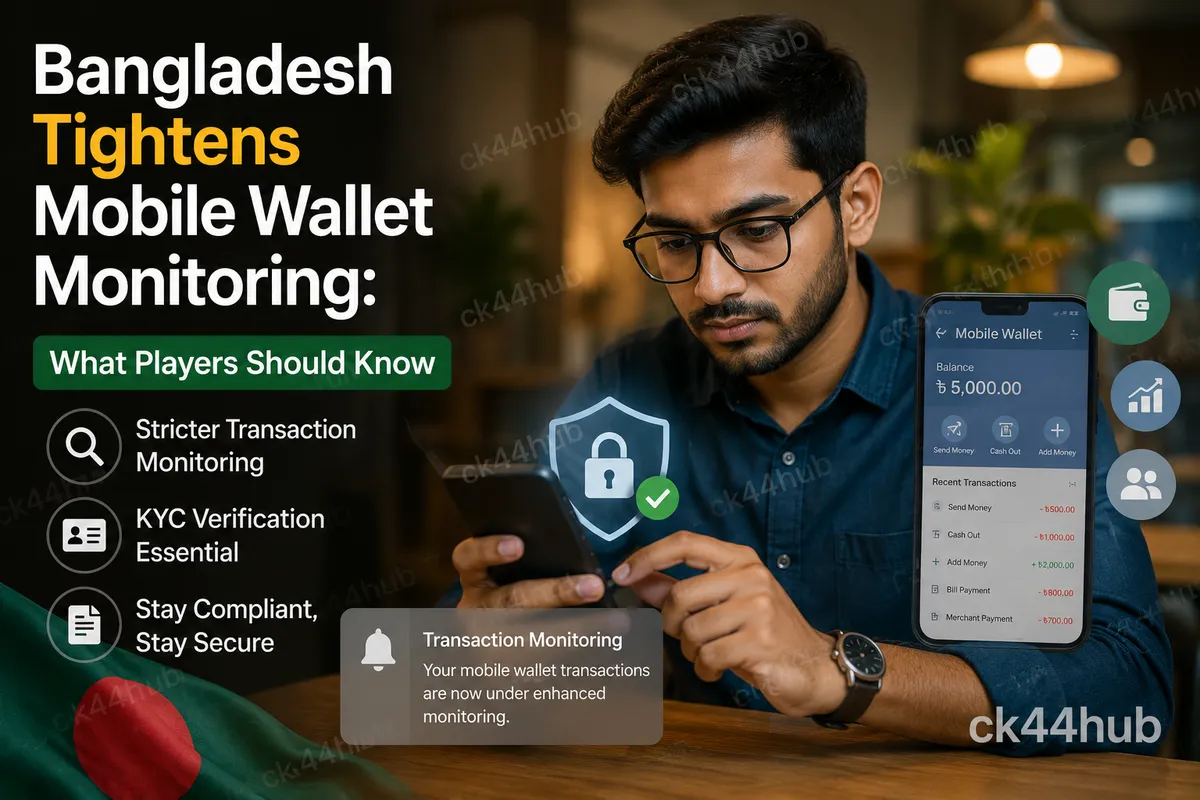
Bangladesh has moved mobile wallet monitoring from a one-time sweep into an ongoing, AI-assisted process, and players who deposit through bKash, Nagad, or Rocket should understand the direction clearly. The honest answer is not a clever trick to dodge detection. It is cleaner deposit behaviour, realistic expectations, and a backup plan before anything gets locked. Bangladesh Bank has directed mobile financial service providers to flag, list, and restrict accounts linked to gambling flows, and to build teams and tools that read transaction patterns continuously. Earlier reporting documented over a thousand accounts shut down in a first round, while later figures reported by national media run far higher across 2023 to 2025. Exact current totals should be confirmed against the regulator before being quoted as today’s number. This guide explains what the system actually does, which patterns raise risk, what happens after a flag, and how to keep a legitimate account usable, without pretending any method makes a legally sensitive activity safe.
Thursday evening. 7:18 PM. Rakib, 31, a mobile-shop technician at Stadium Market who lives in Mirpur 10, tried to top up his casino balance between customers. The first transfer failed. He retried. The second went through, then his bKash showed a hold a few minutes later. He had seen the earlier news about a thousand accounts being frozen and assumed it was someone else’s problem. In his Telegram group, three other people were posting the same screenshots that evening: pending holds, slow withdrawals, support tickets going nowhere. One of them, a cousin who works at a bank branch in Motijheel, sent a voice note saying the central bank had pushed providers to widen monitoring far beyond the first round. Rakib was not arrested, not summoned, not famous. He was just one ordinary deposit in a much bigger pattern the system had started to read. This article is what that bank-clerk cousin would have explained with a full evening instead of a thirty-second voice note.
What Is the Monitoring System Bangladesh Bank Pushed For?
It is an ongoing, AI-assisted review where providers flag, list, and restrict accounts tied to gambling flows, instead of a single sweep. Bangladesh Bank directed bKash, Nagad, and Rocket to build monitoring teams, prepare suspect-account lists, and run public complaint channels, so the review surface keeps growing.
The first stage was small enough to feel like background noise. The verified baseline was over 1,000 accounts shut down for gambling links, with the central bank directing AI monitoring of bKash and Nagad transactions. The current stage is different in scale. Providers were told to set up dedicated teams, submit suspect lists to the regulator, and run complaint portals and helplines. That structure does not stay still. It expands as the lists grow, and an account that looked fine in an earlier sweep can still be flagged later if the pattern continues. For the official framework, read the directives from Bangladesh Bank.
Which bKash and Nagad Patterns Does the System Flag?
The patterns most likely to flag an account are repeated transfers to the same casino-linked recipients, rapid in-and-out movement, many small deposits in a short burst, and friend-funded or group top-ups into one personal number. Monitoring reads behaviour, not intent.
A personal wallet is expected to look personal: bills, family transfers, recharge, normal shopping. When the same account starts sending repeated amounts to numbers already on a suspect list, or cycles money in and out at odd hours, the pattern stops looking personal. Splitting one deposit into many tiny transfers does not always help; a burst of small sends can look as suspicious as one large one. The table below sorts the main patterns by risk and gives a safer alternative for each. Treat it as a behaviour guide, not a loophole list.
| Pattern Type | Risk Level | Why It Flags | Safer Alternative |
|---|---|---|---|
| Repeated transfers to same casino-linked number | High | Recipient may already be on a suspect list | Use only verified, current cashier details; deposit rarely |
| Many small deposits in a short window | High | Burst pattern reads like structuring | Fewer, planned deposits within a fixed budget |
| Rapid in-and-out money movement | High | Mimics agent or laundering behaviour | Keep personal and any gaming activity clearly separate |
| Friend-funded or group top-ups | Medium-High | Multiple senders into one personal number | Move only your own funds; never act as a collection point |
| Odd-hour high-frequency sends | Medium | Timing clusters stand out to pattern models | Normal-hour, low-frequency activity |
What Happens After Your Account Gets Flagged?
A flag usually means a hold, restriction, or review, not an instant ban. The first mistake most people make is retrying, which looks worse. The calmer path is to stop, document everything, and contact official provider support rather than third-party “agents” promising fast unblocks.
A failed or held transfer that is repeated five times reads as more suspicious, not less. Panic-shifting funds to a friend or a new account can spread the flag instead of escaping it. Open the in-app support flow, note the exact error and reference number, and use the official helpline at bKash or Nagad. If the account holds legitimate money, say so plainly and keep proof of normal use such as bills or salary credits. Recovery timelines vary by provider review and are not guaranteed, so treat any fixed “X days” promise from an outside party as unverified.
How Can Players Keep Their Accounts Clean?
Keep the account ordinary: fewer, planned transactions within a fixed budget, no acting as a collection point for others, and personal money kept separate from any gaming activity. The goal is an account that looks normal, because ordinary is what monitoring is least interested in.
None of this is a guarantee, and that honesty matters. Monitoring driven by AI flagging can still reach a careful user, and the underlying activity remains legally sensitive under Bangladesh’s current rules. What clean habits do is lower the obvious triggers. Decide a monthly limit and hold to it, avoid turning a personal number into a shared wallet, and do not chase a loss with a second or third quick deposit. For the safer-play framework, see the CK44 responsible gaming guide, for local payment context read the CK44 payment notes, and for the legal side see our Cyber Security Act amendment explainer.
Frequently Asked Questions
Why did Bangladesh Bank widen the crackdown beyond the first 1,000 freezes?
The first round proved the system worked. The central bank then directed all MFS providers to build AI flagging teams, prepare suspect lists, and run complaint channels, turning a one-time sweep into ongoing monitoring. Wider totals are reported but should be confirmed against the regulator before being stated as fact.
How do I know if my bKash or Nagad account is at risk?
Risk rises with repeated transfers to the same casino-linked numbers, many small deposits in bursts, rapid in-and-out movement, and friend-funded top-ups. If your account behaves like a collection point or an agent rather than a normal personal wallet, it is more exposed.
What is the fastest way to recover a restricted MFS account?
Stop retrying, then contact official provider support through the app and helpline with your reference numbers and proof of legitimate use. Avoid third-party “unblock agents.” Timelines vary by provider review and are not guaranteed.
Are bank transfers safer than mobile wallets right now?
Not officially. Bangladesh Bank’s directive covers all MFS providers, and banks run their own monitoring and suspicious-activity reporting. Switching rails changes the surface, not the legal reality. Clean, low-frequency behaviour matters more than which provider you choose.
Can my account be frozen for past gambling deposits?
Monitoring looks at patterns over time, so older activity can contribute to a flag during an ongoing review. This is why behaviour, not a single recent transfer, shapes risk. Specific cases should be confirmed with the provider rather than assumed.
Will a restriction affect my legitimate, non-gambling transactions?
A restriction can hold an entire account, which may disrupt normal transfers while under review. If your account holds legitimate money, document its normal use and explain it to official support. Keeping gaming activity separate from household money reduces this collateral risk.