CK44 Hub News
Mobile Money in Bangladesh: How bKash and Nagad Changed Daily Life
Fintech · By Michael Max · June 10, 2026
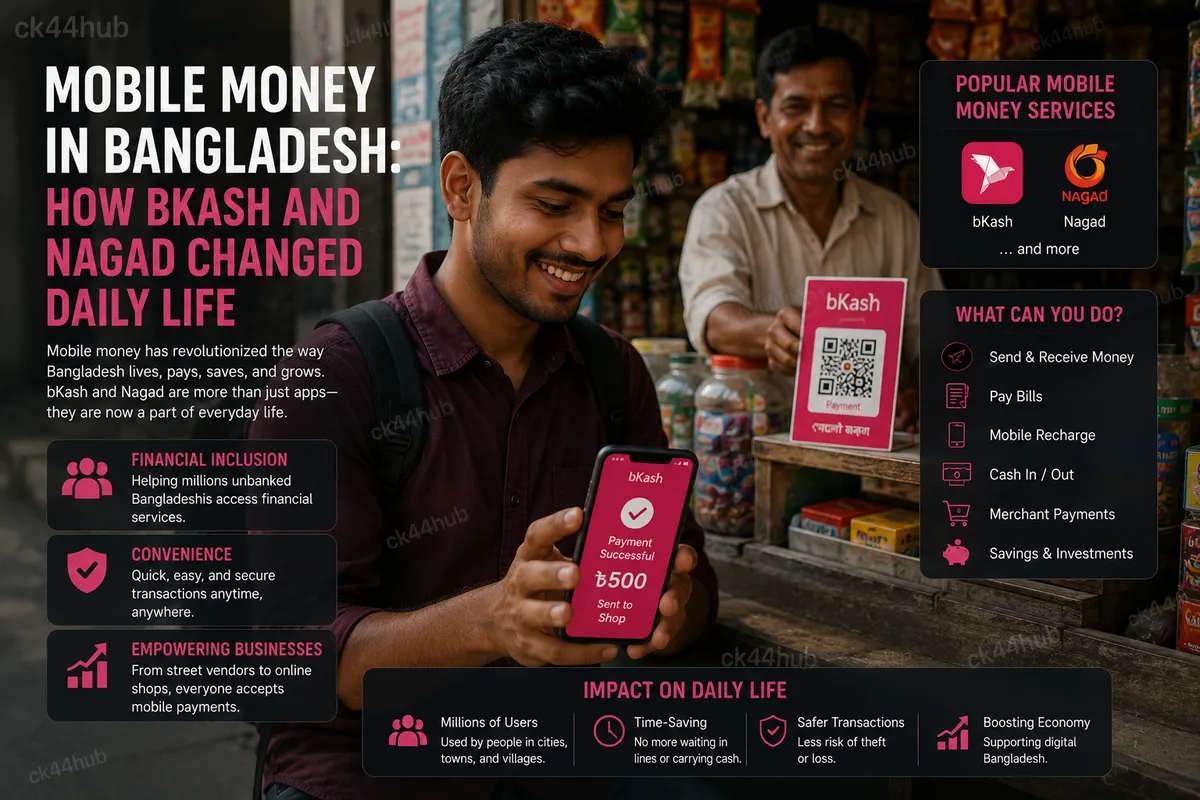
Mobile financial services have quietly become one of the biggest stories in everyday Bangladeshi life, and the numbers are hard to overstate. The honest summary is that mobile money is no longer a convenience for a few; it is core infrastructure used by a huge share of the population for sending money, paying bills, receiving wages, and shopping. Recent reporting puts the total number of mobile financial service accounts in the hundreds of millions, with bKash dominating transactions and Nagad growing fast behind it, while monthly transaction volumes run into the trillions of taka. Behind those figures sits a simpler truth: a vendor in a small market, a worker sending money home, and a family paying an electricity bill all now reach for a phone instead of cash. This explainer looks at how big mobile money has become, what people actually use it for, why it spread so quickly, and what it means for a country where many people were once outside the formal banking system. It uses named sources and avoids invented figures.
Saturday morning. 9:40 AM. Farzana, 33, runs a small grocery stall in a Mirpur kitchen market. A decade ago, every sale was cash, and every evening ended with counting coins and worrying about change. Now a sticker on her shelf shows a mobile money number, and half her customers pay by phone before they have even picked up their bag. Her supplier takes payment the same way, her son’s school fee goes out from the same app, and the money her brother sends from abroad lands there too. Farzana is not a tech enthusiast. She simply found that the phone in her apron pocket did the job that a bank branch, a cash box, and a queue used to do. Multiply her story by millions, and you have the quiet revolution this article is about.
How Big Is Mobile Money in Bangladesh Now?
Mobile money is now used at a national scale, with mobile financial service accounts reported in the hundreds of millions and monthly transaction volumes running into the trillions of taka. bKash leads by a wide margin, with Nagad second and Rocket also in the mix.
Recent industry reporting put the total number of mobile financial service accounts at well over two hundred million, up sharply year on year, with monthly transaction volume reaching roughly Tk 1.7 trillion and rising by about a third compared with the previous year. bKash alone has been reported to serve tens of millions of users and to handle a large majority of all mobile money transactions. These figures move over time, so treat any single number as a recent snapshot to confirm rather than a fixed total. The scale is the point: this is mainstream infrastructure, not a niche app. For the regulator’s view, see Bangladesh Bank.
What Do People Actually Use bKash and Nagad For?
People use mobile money for the ordinary business of life: sending money to family, receiving wages and remittances, paying utility and school bills, topping up phones, and increasingly paying shops directly. It has steadily displaced cash in everyday retail.
The everyday use cases are what make the scale meaningful. A garment worker receives wages digitally instead of in an envelope. A parent in a village receives money from a child working in the city within seconds. A household pays an electricity or gas bill without standing in a queue. A small vendor like Farzana accepts payment without handling change. The table below sketches the main uses and why each matters.
| Use Case | What It Replaces | Why It Matters |
|---|---|---|
| Person-to-person transfers | Cash carried or posted | Instant, safer than carrying notes |
| Wages and salaries | Cash envelopes | Faster, traceable, fewer disputes |
| Bill payments | Queues at offices | Time saved, records kept |
| Mobile top-ups | Scratch cards, agents | Convenience and speed |
| Merchant payments | Cash and change | Smoother sales for small shops |
For official provider information, see bKash and Nagad.
Why Did Mobile Money Grow So Fast?
It grew fast because it solved a real gap: a large unbanked population, near-universal mobile phone access, and a dense network of agents who let people cash in and out almost anywhere. Convenience, speed, and reach did the rest.
Three conditions came together. First, many Bangladeshis were outside the formal banking system, so there was no entrenched habit to overcome; mobile money was often the first financial account a person ever held. Second, mobile phones reached almost every household, so the delivery channel was already in people’s hands. Third, a vast agent network, reported in the millions, meant cash could still be added or withdrawn in any neighbourhood, which kept the system trusted even for people who do not fully trust apps. Government and central-bank support for digital payments added momentum. The result was adoption faster than traditional banking ever achieved.
What Does It Mean for the Cash Economy and the Unbanked?
It means a steady shift from cash toward digital, and a bridge into the formal financial system for millions who had no bank account. Mobile money has brought savings, payments, and remittances within reach of people the old banking model never served well.
This is the deeper significance. For many users, a mobile wallet is not just convenient; it is their entry point to formal finance, a place to receive, hold, and send money safely. That inclusion has real effects: easier remittances, more reliable wages, and small businesses that can take digital payment without a card machine. The shift is not complete, and cash still matters, especially in rural areas and among older users. But the direction is clear, and it has reshaped daily life faster than almost any other technology in the country. For the technology side of this shift, read our smartphones in Bangladesh explainer, and learn more about our team on the CK44 Hub about page.
Frequently Asked Questions
How many mobile money accounts are there in Bangladesh?
Recent reporting puts the total number of mobile financial service accounts in the hundreds of millions, well above two hundred million and rising year on year. One person can hold more than one account, so the account total is higher than the number of unique users.
Which mobile money service is the biggest?
bKash leads by a wide margin and has been reported to handle a large majority of all mobile money transactions, with tens of millions of users. Nagad is the fast-growing second player, and Rocket is also part of the market.
What do people mainly use mobile money for?
The most common uses are sending money to family, receiving wages and remittances, paying utility and school bills, topping up phones, and paying shops. It has steadily replaced cash in everyday retail and personal transfers.
Is mobile money only for people with bank accounts?
No. One of its biggest impacts has been reaching people outside the formal banking system. For many users, a mobile wallet is the first financial account they have ever held, which is why it is described as a bridge to financial inclusion.
Are these figures fixed?
No. Account totals, transaction volumes, and user numbers change constantly and are reported on different dates by different sources. Treat any single figure as a recent snapshot to confirm against the latest data rather than a permanent total.