CK44 Hub News
Smartphones in Bangladesh: Inside the Mobile-First Boom
Technology · By Michael Max · June 9, 2026
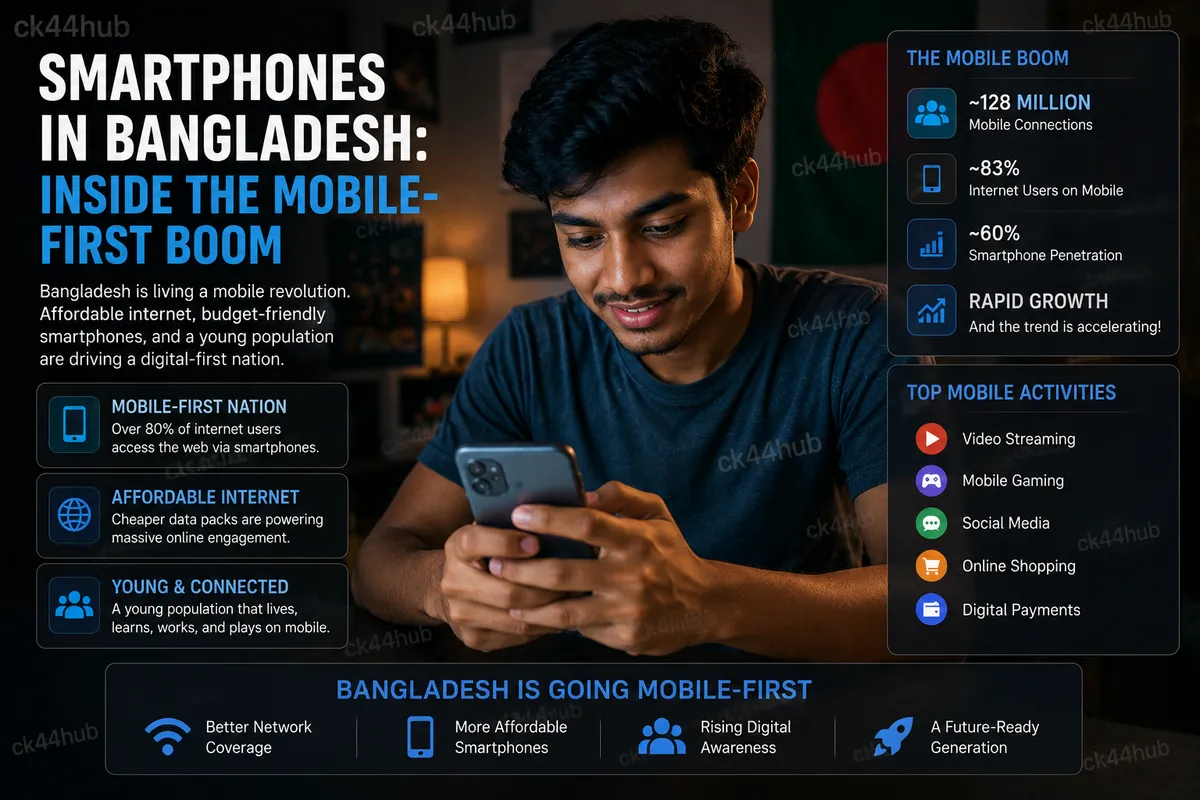
Bangladesh has become one of the most mobile-first countries in the world, and for most people the smartphone is not a second screen, it is the only screen. The honest summary is that a large majority of households now own a smartphone, mobile phone access is near universal, and the overwhelming share of internet use happens on phones rather than computers. Recent figures put household smartphone ownership above seventy percent, mobile phone access close to universal, and mobile subscribers well past the 180 million mark, while Bangladesh leads global rankings for the share of web traffic that comes from mobile devices. Internet penetration is still growing rather than complete, and real gaps remain by gender, region, and connection quality. This explainer looks at how widespread smartphones and mobile internet have become, why the country leaned so heavily on phones, what the shift enables in daily life, and where the gaps still sit. It uses named sources and treats every figure as a recent snapshot to confirm rather than a fixed number.
Wednesday evening. 6:15 PM. Tanvir, 22, a university student in Tejgaon, does almost everything on a phone that cost less than a month’s part-time wages. He attends an online class, edits a document for a group project, watches a tutorial, messages his family, and pays for dinner, all on the same handset, often on mobile data rather than wi-fi. He does not own a laptop and has never felt he needed one. For Tanvir, and for tens of millions like him, the smartphone is the computer, the bank, the classroom, and the television rolled into one. That single fact explains more about how Bangladesh lives online than any chart, and it is the starting point for this article.
How Widespread Are Smartphones and Mobile Internet?
Smartphones are now owned by a large majority of households, mobile phone access is close to universal, and mobile subscribers number well past 180 million. The overwhelming majority of internet use in Bangladesh happens on phones rather than desktops.
Recent reporting put household smartphone ownership above seventy percent and overall mobile phone access near ninety-nine percent of households, with total mobile subscribers reported past the 180 million mark. Internet users number in the tens of millions, with penetration around the half-of-population range and still climbing. Most strikingly, Bangladesh ranks at or near the top globally for the share of web traffic coming from mobile devices, well above countries like the United States. These figures shift over time and vary by source, so treat each as a recent snapshot to confirm rather than a permanent total. The table below gathers the headline numbers.
| Indicator | Recent Figure | What It Shows |
|---|---|---|
| Household smartphone ownership | Above ~72% | Smartphones are mainstream, not a luxury |
| Household mobile phone access | Near ~99% | Almost everyone can be reached by phone |
| Mobile subscribers | Past ~186 million | Connections exceed many countries’ populations |
| Internet users | Tens of millions, ~half of population | Online, but penetration still growing |
| Mobile share of web traffic | Among the highest globally | The phone is the primary internet device |
For official telecom data, see the BTRC.
Why Is Bangladesh So Mobile-First?
Bangladesh is mobile-first because phones arrived before widespread home computers or fixed broadband, they are far cheaper than laptops, and mobile networks reach places wired internet never did. For most people, the phone was simply the first and only practical way online.
The pattern is common across fast-growing economies, but Bangladesh shows it in an extreme form. Affordable handsets and prepaid mobile data lowered the cost of getting online to within reach of ordinary incomes, while fixed-line broadband stayed limited and concentrated in cities. Mobile networks, by contrast, spread widely, so a phone became the default gateway to the internet rather than a complement to a computer. Add a young population comfortable with apps, and the result is a country where digital life is designed for a small screen and one hand first, and a desktop second, if at all.
What Does the Digital Shift Enable in Daily Life?
The shift puts services, work, learning, payments, and information in everyone’s pocket. People bank, study, find work, run small businesses, and stay informed on a phone, often on mobile data, without ever needing a computer or a branch.
The practical effects are everywhere. Mobile money lets people pay and get paid without cash, a change covered in our mobile money in Bangladesh explainer. Students attend classes and watch tutorials on phones. Freelancers and small sellers reach customers through apps and social platforms. Farmers and traders check prices and information that once required a trip to town. Faster mobile networks, with median download speeds rising sharply year on year, make video, calls, and services smoother than they were even a short time ago. The phone has become the main tool for participating in the modern economy, not a toy on the side.
What Gaps Still Remain?
Real gaps remain in penetration, gender, region, and connection quality. Internet use is still growing rather than universal, women own and use phones less than men, rural access trails cities, and speeds and affordability are uneven across the country.
The boom is real, but it is not finished or evenly shared. Overall internet penetration sits around half the population, which means tens of millions are still offline. A persistent gender gap shows men owning and using mobile internet more than women. Rural areas, older users, and lower-income households often have older devices, slower connections, or limited data budgets. Digital skills and trust also vary widely. Recognising these gaps matters, because the headline story of a mobile-first nation can hide the people still waiting for their turn. For more on our editorial approach and team, see the CK44 Hub about page.
Frequently Asked Questions
How many people in Bangladesh use the internet?
Recent figures put internet users in the tens of millions, with penetration around half the population and still growing. That means a large and rising number of people are online, but tens of millions remain offline, so coverage is far from universal.
Why does Bangladesh rely so heavily on mobile?
Phones arrived before widespread home computers and fixed broadband, they are much cheaper than laptops, and mobile networks reach areas wired internet never did. For most people, a phone was the first and only practical route online, so the whole digital experience is built mobile-first.
How many mobile subscribers does Bangladesh have?
Recent reporting puts total mobile subscribers past the 180 million mark. Because some people hold more than one connection, the number of subscriptions can exceed the number of unique users, so it is best read as connections rather than individuals.
Is mobile internet fast in Bangladesh?
Median mobile download speeds have risen sharply, by roughly a third in a recent twelve-month period, which makes video and services smoother than before. Speeds and reliability still vary by area, network, and device, so experiences differ across the country.
Is the digital boom shared equally?
No. Real gaps remain by gender, region, age, and income. Men use mobile internet more than women, rural and older users often have slower connections, and overall penetration is still climbing. The mobile-first headline hides millions who are not yet fully connected.